
Fasting before sedation dentistry
Learn why fasting is required before dental sedation, how long to avoid food and liquids, and what to expect on the day of your appointment.
Read guideCompare IV, oral and nitrous sedation, understand what it costs and how the day feels, and find a verified sedation dentist in your state.
Sedation types
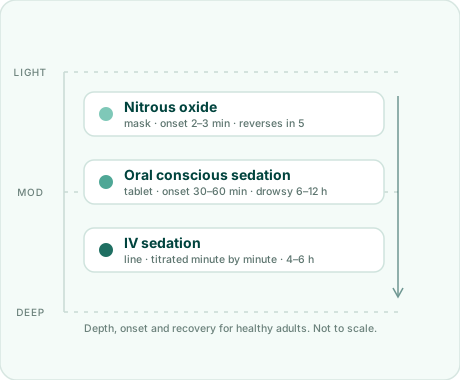
The three options a general dental office offers, from lightest to deepest, and what each one actually feels like.
Moderate sedation given through a vein and titrated minute by minute by the dentist or anesthesiologist.
A single tablet taken at home or in the waiting room; lighter than IV and slower to wear off.
Laughing gas breathed through a nose mask — the depth is adjustable and reverses within minutes.
Guide library
The six guides most readers begin with — what sedation is, which type fits which appointment, what it costs and whether it is safe.
An overview of sedation dentistry, the types of dental sedation, how they work, and what to expect during treatment.
Learn how oral conscious sedation works, what to expect on the day of treatment, and how it compares with other sedation options.
Understand how sedation dentistry cost varies by method, including IV, oral, and nitrous oxide, and what factors influence the final price.
A clear overview of sedation dentistry safety, common risks, monitoring standards, and how to discuss concerns with your dentist.
Learn why fasting is required before dental sedation, how long to avoid food and liquids, and what to expect on the day of your appointment.
Compare IV sedation and oral sedation for dental procedures, including onset, control, recovery, and safety considerations.
Choosing a level
Both are moderate sedation, but they differ in how fast they start, how deep they go and how long the day is written off. Five rows tell most of the story.
| Feature | IV sedation | Oral sedation |
|---|---|---|
| How it is given | An IV line in the arm, placed at the appointment | A single tablet, usually triazolam, before the visit |
| Depth | Moderate — drowsy, drifts in and out, responds to voice | Light to moderate — sleepy but easily roused |
| Onset | Three to five minutes, titrated during treatment | Thirty to sixty minutes, so timing matters |
| Recovery | Four to six hours; no driving or work that day | Up to twelve hours in some patients; no driving |
| Best for | Long or surgical visits, strong gag reflex, high anxiety | Shorter visits and milder anxiety |
Sedation dentistry directory
0 listed practices across 0 states, with 0 published city directories.
Browse by state:
From the blog
Learn why fasting is required before dental sedation, how long to avoid food and liquids, and what to expect on the day of your appointment.
Read guideA clear overview of sedation dentistry safety, common risks, monitoring standards, and how to discuss concerns with your dentist.
Read guideCompare IV sedation and oral sedation for dental procedures, including onset, control, recovery, and safety considerations.
Read guideLearn how oral conscious sedation works, what to expect on the day of treatment, and how it compares with other sedation options.
Read guideUnderstand how sedation dentistry cost varies by method, including IV, oral, and nitrous oxide, and what factors influence the final price.
Read guideA calm, clinical guide to the types, safety, and preparation steps for pediatric dental sedation.
Read guidePatient FAQ
Clear, direct answers to the questions dentists hear most often, written from published clinical guidance.
In the United States, nitrous oxide typically adds $50 to $150 to a visit, oral conscious sedation $150 to $400, and IV sedation $300 to $800 or more, depending on the city and the length of the appointment. The dental work itself is billed separately, and insurance rarely covers the sedation fee.
For healthy adults, moderate sedation in a dental office has a strong safety record when the team screens for airway risk, monitors oxygen saturation and blood pressure, and uses the right drugs at the right depth. Risk rises with untreated sleep apnoea, obesity, severe heart or lung disease, and when monitoring is skipped.
No. After oral or IV sedation you cannot drive, operate machinery, or be alone with small children for the rest of the day. Arrange a responsible adult to collect you and stay with you for several hours; most practices will not begin IV sedation without one.
Sedation keeps you breathing on your own and able to respond to voice; general anaesthesia makes you unconscious and usually requires a protected airway and an anaesthesia professional. Most dental sedation is moderate sedation, not general anaesthesia.
Sedation is used in paediatric dentistry, but the evidence and the safety requirements are different: a child needs weight-based dosing, continuous monitoring and a team trained in paediatric airway rescue. It should be reserved for children who cannot cooperate after behaviour guidance has been tried.
Usually not as a standalone benefit. Some plans cover sedation when it is medically necessary — for example for a documented phobia, a disability, or a procedure that cannot be done awake — and many exclude it as elective. Ask for the billing codes before the appointment and confirm with your insurer.